 |
| |
|
Dear Friends,
Please share this newsletter with people you think will be interested in it, and encourage people to subscribe.
|
 |
|
Extractives and Water
|
|

|
|
Holding onto Gains in Transparency Legislation
The U.S. Chamber of Commerce, the American Petroleum Institute (API) and factions within the U.S. Congress are working to undo work done by Presbyterians and other allies to help redirect millions of dollars used for corrupt purposes toward alleviating poverty, building infrastructure, as well as schools and clinics in resource-rich nations, through a mandatory reporting standard established in Section 1504 of the Dodd-Frank Wall Street Reform and Consumer Protection Act. Learn More
|
|
|
|
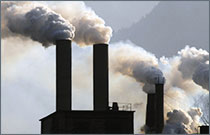
Global Warming and Climate Change in the Central Andes of Peru
Peru is one of the most vulnerable countries in the world to the catastrophic effects of climate change. The increase in natural disasters has a greater effect on impoverished countries because they find themselves at greater risk and vulnerability. Climate change accentuates social and economic inequalities that exist as can be seen in increased food prices, the millions of people that are starving in the world, the millions of climate refugees, lack of water suffered by millions, increased sickness, and other adverse effects on humanity. Learn More
|
|
|
|
|
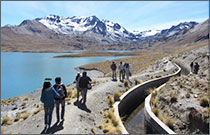
Youth Confront their Realities in Relation to Water and the Environment
UMAVIDA developed the “Water School” to work with youth, developing their knowledge of the water system and the threats with which it is faced, and train them to take action in their communities. The school works by encouraging youth to raise their voices in their communities, protest the degradation and contamination of water resources, develop solutions that apply to their contexts and become committed and engaged in supporting local actions. Learn more
|
|
|
Trade Reform
|
|
|
|
|
Shining a Light on Corruption
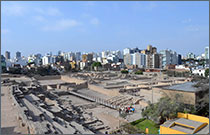
Peru continues to have one of the fastest growing economies in Latin America. Much of the growth is based on mining profits. However, many of these mining projects create social and environmental problems and fail to consult with indigenous people living in the project areas despite laws which protect their authority to accept or deny mining within their territories. Learn More
|
|
|
|
|
Chasqui Recognitions: Giddings-Lovejoy Presbytery Honors the Past While Calling into the Future
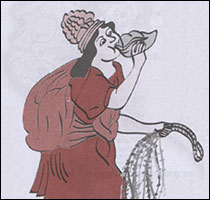
The Presbytery of Giddings-Lovejoy celebrates 15 years of partnership with Peru through Joining Hands and honors those who contributed to the success of the network along the way. Joining Hands members of the Presbytery are now living into a new call to be international trade activists. They are seeking trade reform so that international commerce benefits all people, not just the wealthy, and transparency in trade negotiations so that decisions are not made behind closed doors. Learn More
|
|
|
Food and Land
|
|
|
|
“Quit India!” Historical Slogan Energizes a New Seed Sovereignty Movement in India
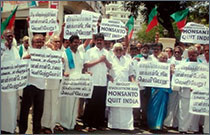
More than 2000 citizens, mostly farmers, came from 20 states in India to protest a new Bill which proposes a fast-track approval mechanism for biotechnology, permitting entry of risky Genetically Modified Organisms (GMOs) into food, farming and the environment with little or no oversight. A seed sovereignty movement has emerged and is using the “Quit India” slogan, used originally by Mahatma Ghandi when struggling for Indian independence from British rule, to demand the expulsion of Monsanto and GMOs from India. Learn More
|
|
|
|
|
Internally Displaced Persons (IDPs) in Sri Lanka Struggle for Land Access
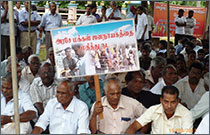
More than 115,000 persons remain internally displaced, suffering from a lack of basic facilities, security and livelihood assistance, after the end of 26 years of war in Sri Lanka. However, the Government of Sri Lanka maintains that all of the IDPs have been resettled. Currently, the remaining IDPs are mobilizing to regain their lands from military occupation. Learn More
|
|
|
|
|
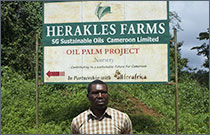
Land Grab in Cameroon: Learning from the Field
A delegation from the PC (USA) traveled to Cameroon to learn about land grabbing from the ground. They witnessed to the good work that RELUFA and its partners are doing to lift up the voices of the 20,000 people whose culture and livelihoods are being threatened by the multinational corporation’s palm oil plantation. Learn More
|
|
|
|
|
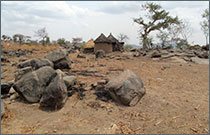
Cameroon Declared to Have Achieved Millennium Development Goal 1: Rhetoric or Reality?
During the 38th Conference of the Food and Agriculture Organization (FAO), held in Rome, Italy June 17-22, 2013, 38 countries were declared to have reduced hunger by half, well ahead of the international target set for 2015. Paradoxically, Cameroon features among the 38 countries that are considered by the FAO to have achieved Millennium Development Goal One (MDG 1). Food justice campaigners in Cameroon question the positive appraisal in the face of declarations of emergency food crises in rural areas of northern Cameroon. Learn More
|
|
| |
|
Please consider giving a donation to the Presbyterian Hunger Fund. Together we can end hunger!
|
|
|
Resources and other news
|
|
Food Sovereignty Prize honors 3 member organizations of FONDAMA Haiti
Watch our webinar on Curbing Corruption and Conflict
Radio interview with Lori Hylton and Jed Koball on TPP and Fast Track
Peruvian city among top 5 worst polluted in the world, according to study Peru This Week
Fighting “Land Grabs” in Africa Africa Faith & Justice Network
|