


Faith, fear, and toenails
For a squeamish volunteer, a foot clinic for the homeless means stepping out of a comfort zone.
by Scott Dannemiller
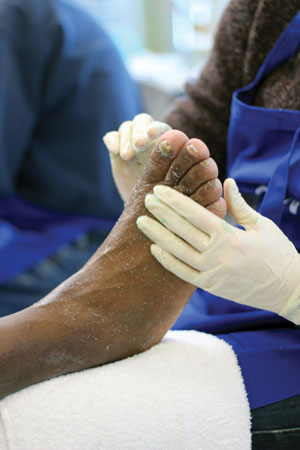
You ready for lunch?” my wife asked.“Not yet,” I said. “Just need to pick a homeless man’s toenails out of my hair.” She nodded, like it was perfectly normal. And it was.
Allow me to explain. A number of years ago, my wife, Gabby, and I quit our corporate jobs and spent a year in Guatemala as PC(USA) Young Adult Volunteers. While we had grand plans for saving the world, that obviously didn’t pan out. But we were filled with gratitude for coming face to face with the grace of God manifested in the generosity of strangers.
Ever since then, we’ve felt compelled to give back in some way—to push ourselves to the edge of our faith. That opportunity came when we received an invitation from Jeff Moles, a friend and former YAV, to volunteer at a foot clinic for the homeless in our hometown of Nashville, Tennessee. (See sidebar.)
Now, if you’re a nurse, masseuse, podiatrist, or shoe salesman, this might not be a big challenge for you. But me? I have a long list of fears, most of which are related to personal hygiene. So this scared the living daylights out of me.
After weighing Jeff’s invitation and my own considerable apprehension, I gave him the only answer that made sense: challenge accepted.
Diving in, feet first
When we arrived for the orientation, I noticed lots of other volunteers. Some were YAVs, and some were regular volunteers, including an especially cheerful woman named Dolores from Westminster Presbyterian Church in Nashville. Even so, I guessed I was the only one who might need a mild sedative to get through the experience.
I figured I’d start small. Help people fill out the intake form. Wash the trimmers and pumice pads between sessions. You know, ease my way into it. But 30 seconds after my arrival, a volunteer coordinator in Jeff’s office tapped me on the shoulder.
“We have a space open for foot care. Can you help out?”
The next thing I knew, I was seated on a stool in front of a metal folding chair. On the floor was a washtub filled with warm water. Another volunteer came by and gave me three towels, rubber gloves, nail trimmers, a pumice stone, a nail file, soap, and lotion.
“Do you need a cheat sheet?” he asked.
I nodded.
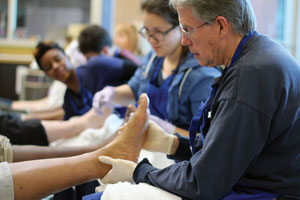
Volunteer Bart Perkey joins nursing students from Lipscomb University to help out at the Room in the Inn foot clinic, a program for the homeless in Nashville, Tennessee.
He brought me the instructions: Soak feet. Wash feet with cleanser. Clean under toenails with cuticle stick. Clip nails. Apply callus remover. Scrub with pumice stone to remove calluses. Massage feet with lotion.
The instructions might as well have added, Try not to look like you’re going to soil yourself.
When I finished reading, he asked, “Are you ready?”
I prayed for God to settle my nerves—and if it wasn’t too much trouble, he could do this by sending me a client with dainty, pretty feet. Like Jennifer Aniston. Or Halle Berry.
I’m not picky.
God’s reply?
“Hi. This is Raymond.”
Raymond bore no resemblance to Jennifer Aniston or Halle Berry, and he had feet the size of canned hams. I swallowed my fear and motioned toward the chair before me, saying, “Make yourself comfortable.”
As Raymond removed his shoes, I asked him if he had any spots on his feet that I needed to be careful with. He removed his white athletic socks, pointing to piggy number two on his left foot.
“See that one?”
“Yes,” I replied, gazing at a thick, discolored nail.
“It has a fungus on it. If you could smooth that one out a bit, I’d appreciate it.”
I got right to work. Raymond and I chatted a bit. He had been in construction but lost his job in the economic downturn. He had no place to live. As I scrubbed his size 12s with a cleanser, I smiled at the sight of myself. Here I was, a goofy, skinny, pale corporate consultant, caressing the sudsy feet of a homeless man nearly twice my size. It’s not an image I could have conjured up just a few days before. But now it had an air of normalcy to it.
Before Raymond left, he said: “Man, I spend a lot of time on my feet. This is just what I needed.”
Perhaps it’s what I needed too. His expression of gratitude was both touching and humbling. After Raymond, I cared for the feet of two other people. As I trimmed nails and smoothed calluses, we chatted about the challenges they faced and the ups and downs of the cycle of poverty. In that moment, I finally stepped outside myself to see how tough this must be for them. During the good times, you have a steady job and the means to put a roof over your head. Then something happens, and the rug gets ripped out from under your tired feet. That’s when you have to swallow your pride and admit you can’t do it alone. I can only imagine how much I would resist that.
But here they were, reluctantly accepting grace. I easily saw myself in their shoes.
Nailing the challenge
My fourth client was about six foot three, with plenty of gray hair on his temples. I’m not sure of his age, but his skin showed that whatever years he had spent on the planet had been hard.
“Hi. I’m Charles.”
“Nice to meet you,” I said, adjusting the wash basin on the floor. “Get comfortable.”
Charles wasted no time.
“I want them two things gone!” he said with authority as he pointed to his left foot. “It’s been years since I’ve done anything to that one!”
Years?
He touched the nail on his big toe, which, like all the others, had grown for so long that it covered the front of the toe like a thick, giant thimble. The only thing that prevented it from growing even more was that the bottom of his foot had acted as a file of sorts. Otherwise, it would have covered the soles of his feet. He touched his big toenail and a marble-sized growth on the second toe and repeated:
“I want them two things gone.”
Dumbfounded, I turned toward
the volunteer seated on the stool at my right, a registered nurse.
“Anything special I need to do here?” I asked, secretly hoping she’d take my case as a research project. She only giggled at my novice trepidation and said:
“Nothing special. Just trim the nails as best you can, and get a few corn pads to help with the bump.”
I was petrified. I scrubbed his feet with the special soap, hoping against hope that the concoction would work as a toenail solvent, making the problem areas just disappear.
No such luck.
After the soap, I was supposed to use the cuticle stick to get under the nails. I looked down at the poor stick and heard it faintly whimper, so I moved on to the pumice stone to allow more soak time. Before I went to work on the thick calluses, I told Charles, “Let me know if this is too uncomfortable for you.”
He replied, “Ain’t nothin’ gonna hurt these big size 13 canoes, boy. ”
I worked his foot like an auto body mechanic sanding paint off a Buick. I commented: “I think I may rub off a size or two here, Charles. When you walk out of here, you may be an 11½.”
He laughed, and then added: “This feels real good. I really appreciate you doing this.”
When the scrubbing was done, it was nail time. Because of the unique growth, there was no way to just take each nail off in one clip. I would have to take them all off a quarter-inch chip at a time. The trimmers were the kind that look like a pair of pliers. I grabbed them firmly in my right hand and settled in on the first nail.
I may not be the strongest man in the world, but I’ve done my fair share of working out. Still, when I pressed down, the trimmers didn’t clip. They merely made an impression—like I was notarizing his big toe. Refusing to yield, I grabbed on with both hands and clamped down. There was a sound like someone snapping a pencil, and the first chunk of nail flew off and hit the nurse in the cheek.
“Hold on there, now!” Charles joked. “I don’t wanna be responsible for hurtin’ nobody.”
I had to laugh, and so did the nurse. I continued chopping away at the nail. The big toe alone took four minutes. Stuff was flying everywhere. The area around my seat looked as if someone had been whittling one of those bear statues out of an old stump. Toenail chips hit me in the eye, the cheek, and the lower lip. My waxy hair-care product—an unfortunate choice this day—trapped slivers against my head.
And God was blessing it all. Beauty for ashes, as they say.
Because as tough as this was for me, it was 10 times as difficult for Charles. If you have no money and no place to live, toenails are the least of your worries. And when you look like Charles, out on the street, it’s likely that you would go weeks, if not months, without feeling the physical touch of another human, save for an occasional police officer lifting you off a bench and pointing you elsewhere for the night.
Can you imagine? I can. Now.
It must be very lonely. And enough to make you feel less than human—people approaching you like I had Charles and the others, as a pair of feet instead of a human with a soul.
Learn more
To find out more about Nashville’s Room in the Inn and its homeless ministry: roomintheinn.org
To explore the Young Adult Volunteer experience or consider applying: pcusa.org/yav
When his feet were back to normal, Charles looked at my handiwork and exclaimed: “Those babies haven’t looked that good in years! Thank you!”
“We’re not done yet,” I reminded him. “We save the best for last.”
I poured peppermint-scented lotion into my hands and massaged his God-given feet for 10 lovely minutes. Like the others before him, Charles leaned back in the chair, closed his eyes, and sighed. It was the sound of pure peace. Breathing in a pleasant scent. Both of us drenched in human kindness. Bringing a subtle smile to my face as fear melted into the floor. Showing. Telling. Proving that when you push yourself to the edge of your faith, grace and gratitude will follow.
Scott Dannemiller is a worship leader, a former PC(USA) Young Adult Volunteer, and now the president of LifeWork Associates. He is also the voice behind the blog The Accidental Missionary, where a version of this article first appeared. His book, The Year without a Purchase: One Family’s Quest to Stop Shopping and Start Connecting, is due out this fall through Westminster John Knox.
Despite initial misgivings, Jeff Moles finds a calling
by Scott Dannemiller
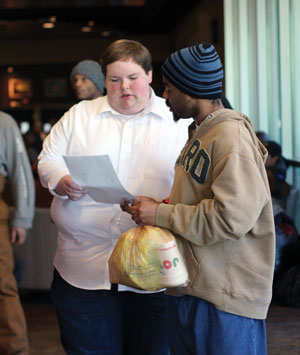
Jeff Moles, community development coordinator for Room in the Inn, visits with a homeless man receiving services at Room in the Inn.
When you ask Jeff Moles about his first day on the job as a PC(USA) Young Adult Volunteer, you get a surprising answer.
“By lunchtime, I wanted to go home and just stay there.”
His reply is consistent with the deadpan, comedic response he freely offers to friends and strangers alike, but the answer is no joke.
“When I arrived for the first time, the alley was filled with people I’d never been around before. I’d never spent any time with the homeless.”
That is no longer the case. Since that day, Moles has chosen to stay in Nashville, where he now serves as a ruling elder in the PC(USA), works as staff at Trinity Presbyterian Church, and fills the role of community development coordinator for Nashville’s Room in the Inn, surrounded by homeless friends every day.
Room in the Inn offers emergency services, transitional support, and long-term housing for Nashville’s homeless population. It’s also one of 17 national YAV sites, where several Presbyterian young adults every year work and serve in Christian community.
As Moles meanders through the crowded halls, guests frequently place a hand on his shoulder, offer a hearty hello, or stop to chat and ask questions. The drastic change can be traced back to Thanksgiving nearly a decade ago.
Moles explains: “That day, I was leaving to visit family in Indiana. As I made my way through the crush of people at the door, one woman said, ‘You need to come right back, Jeff, because you know we sure do love you here!’ ”
That simple expression of gratitude was a sign of God’s grace that transformed him from the inside out. Room in the Inn was no longer a place where he worked. It was a place where he belonged.
“Guests at Room in the Inn have people constantly coming in and out of their lives,” Moles says. “I just knew that I wanted to be a consistent presence for them.”
As Moles promotes the work of this ministry, he is quick to acknowledge the sacrifice of roughly 6,500 volunteers, including two YAVs, who work tirelessly to make it successful. In 2014, Room in the Inn’s Winter Shelter program provided more than 60,000 beds, 50,000 showers, and 100,000 meals to homeless guests by partnering with local congregations, including 11 Presbyterian churches, that open their sanctuaries to the homeless from November 1 to March 31 each year.
The ministry was started in 1986 by Charlie Strobel, a Catholic priest who saw a homeless man outside his parish and offered him a sandwich. That single sandwich grew into a ministry providing mobile meals, which led Strobel to wonder what other abundance he could share with those in need. Thinking and dreaming eventually led him to realize that churches, largely empty every day besides Sunday, could be welcoming shelters for those who have no place to go.
Today, Room in the Inn has a gleaming, 65,000-square-foot building in downtown Nashville. The facility offers educational services such as classes in literacy, computer skills, and creative expression; support services, including legal services, transportation, meals, showers, and job placement; a Guest House providing a safe alternative to jail for those with addiction problems looking for recovery services; recuperative services that include a safe place for individuals healing from illness or hospitalization; and permanent housing in 38 efficiency apartments. The apartments ease the transition for those moving into long-term housing, allowing them to maintain a sense of community support before going out on their own.
Considering all this, when asked about his preferred ministry at Room in the Inn, Moles doesn’t hesitate.
“The foot clinic is my favorite thing we do. The condition of your feet tells the story of your life. And you connect with people on a different level when they take off their socks and shoes and put them in your lap.”
That type of deep connection keeps Moles coming back, day after day, to experience the power of God’s grace. In fact, when he reflects now on his initial reaction—“I just wanted to go home”—Moles has this realization:
He’s already there.
