


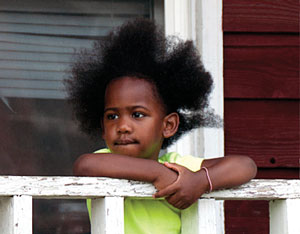
 Each one
Why black lives should matter to the church
By Mihee Kim-Kort
It was my first church mission trip since the twins’ arrival four years ago. We hopped over to West Virginia to a little town called St. Albans to rebuild a deck for a mother of four children.
As young and old worked tirelessly to dig postholes, I watched a little black girl with a poof of hair framing her face peek out at us from the window. I watched 11-year-old Makaya burst forth from the house, all sunlight and giggles, charming us all and playing with the kids.
They were silly together as typical preteens, giggling and squealing while throwing tortilla chips and making up games and jokes. She was tall and lanky, all limbs, with short shorts, a tight gray top, and her hair tied down in two spots and poofed out in the back. Three-year-old Evaline came out to watch, and Makaya grabbed her in a big bear hug as she tried to squirm away. Soon they all crammed together, sitting at the back of the van, and I couldn’t help it. I pulled my phone out to take a photo of them.
They were sweet. Precious. My mind raced through the critiques I had internalized about doing mission trips—how these “projects” cast the incomers as heroes. Did these girls inwardly cringe at my lens pointed straight at them? Did they feel safe? I thanked them and had them look at the photo. They convulsed with glee at their funny expressions.
They demanded I take more photos. Of course, I had to oblige them. I realized in that moment that our being there was one way to tell them they matter and are loved.
Makaya’s world, however, tends to say she does not matter. I look at her, and I’m overwhelmed by all the voices that say she is, or will soon become, a criminal, a threat, a slut, a social climber, or, if she’s lucky, an exception. And it tells her that she’s all these things, in so many explicit and subtle ways, because she is black (and a girl).
Hip-hop artist Talib Kweli wrote his song “Black Girl Pain” for girls like Makaya.
This is for Aisha, this is for Kashera
This is for Khadijah, scared to look up in the mirror
I see the picture clearer through the stain on the frame
She got a black girl name, she livin’ black girl pain . . .
My mama said life would be so hard
Growin’ up days as a black girl scarred
In so many ways though we’ve come so far
They just know the name, they don’t know the pain
So please hold your heads up high
Don’t be ashamed of yourself, know I
Will carry it forth till the day I die
They just know the name
they don’t know the pain, black girl.
Makaya will look at magazine photos of (white) beauty, and maybe she’ll want to hide. She’ll go to a school that’s underfunded. Words like smart and brave may be missing from her vocabulary. College, she’ll be told, is beyond her. Later, she’ll get pulled over while driving even though she wasn’t speeding. If she’s sexually assaulted, many men (and women) will say it was her fault. Then, if she has children, she’ll have to raise her children to be extra careful about what they do in public and near police: don’t drive with more than three friends, be silent, suppress your pride, keep your hands where they can be seen, don’t expect the same treatment as white kids.
One day, she could have a child like Mike Brown.
His body face down on the street. Alone. A pool of blood streaming from his body. Police and tape making a wide berth around him as neighbors begin to gather in the area to protest the death of this young man. His hands in the air (a description corroborated by more than 50 percent of witness statements). Hands to show that they were empty. Hands to show that he was unarmed. Hands that asked for help. Hands that held a cap and gown. Hands that held a diploma. Hands that once held his mother’s hands.
And then there’s Eric Garner, Tamir Rice, John Crawford, Akai Gurley, Freddie Gray.
The movement, commonly dubbed Black Lives Matter, is the attempt by some to change Makaya’s future.
What began as a hashtag on Twitter has become, in three short years, an international phenomenon of more than 700 demonstrations. While focusing on racial profiling, police brutality, mass incarceration, and the militarization of police departments, the movement broadly addresses any and all ways black lives are deprived of power, dignity, and equal rights.
A number of Presbyterian congregations have joined the movement’s ranks, upholding a long tradition of civil rights advocacy in the church. Others have resisted, expressing various concerns—such as for the movement’s tactics or the safety of police officers—or questioning the reality of racism altogether.
Black and white
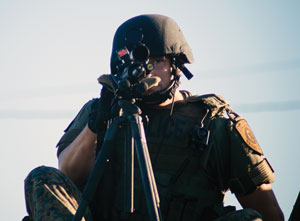
Police sharpshooter trained in the direction of the protests in Ferguson, Missouri, following the killing of Michael Brown
The circumstances around the shooting of Mike Brown are hazy, I know. On the one hand, the Justice Department cleared police officer Darren Wilson of all wrongdoing. On the other, it released a scathing report of the Ferguson Police Department’s routine violation of the constitutional rights of black residents. The details of the shooting are important to Brown’s family, officer Wilson, and the Ferguson community. But debating those details can obscure the point—that African Americans in this country are afraid for their lives.
The fact that police officers may also be afraid is neither contradicted nor subverted by this reality for black Americans. In fact, the two realities are intertwined.
Crammed into ghettos and deprived of economic mobility and adequate education, many communities of color have indeed experienced the almost inevitable rise of gangs, violence, and disrupted family systems. Public perception of this violence is often distorted: while it’s true that black people are most likely to be killed by other African Americans, white people are almost equally likely to be killed by other whites, and yet we rarely hear about white-on-white crime. In some districts, a black child almost never goes a week without being shoved against a wall and searched by police. One mistake, and they’re thrown out of school (thanks to zero-tolerance policies) and into juvenile detention, perpetuating the cycle.
“Blacks are stopped twice as often as whites,” writes Jamelle Bouie in an April article for Slate. “But they aren’t related to traffic safety offenses. . . . Where we see a difference . . . is in investigatory stops. In these, drivers are stopped for exceedingly minor violations—driving too slowly, malfunctioning lights, failure to signal—which are used as pretext for investigations.”
In the 1980s the War on Drugs became, many scholars argue, a war on black people. New minimum-sentencing laws meant that possession of crack cocaine, whatever the amount, carried the same sentence. It just so happens that the vast majority (79 percent in 2009) of crack users are black. In actuality, white people, according to the Bureau of Justice, use most drugs more than African Americans do; yet police arrest black people for drug possession three times as much as they do whites. The result is mass incarceration that, if continued, will imprison (mostly for nonviolent offenses) one-third of the African American population.
Additionally, according to a ProPublica analysis, black teens are 21 times more likely to be shot and killed by police than white teens. The violent deaths that have come to the forefront recently are a snippet of the continuous assault on lives at the margins.
In the beginning . . .
The hashtag #BlackLivesMatter first starting showing up after George Zimmerman was acquitted for shooting and killing 17-year-old Trayvon Martin, whose hooded image was dragged through the media.
When Zimmerman was exonerated, I was in the throes of mind-numbing exhaustion from the birth of the twins. They were about five months old, and I was still in denial that I had any problems, so I chalked it up to hormones and sleeplessness. But I was so angry. Always so angry. Every day, I wavered between the fatigue of raising babies and the growing discomfort of realizing that they were growing up in an ugly and violent world.
At the time I didn’t know what else to do but take the obligatory selfie—in a hoodie. Later, we all wore hoodies to church one hot Sunday morning.
We wore hoodies as a symbol of our helplessness, but also our solidarity, showing that we as a family stood with those who were working to create real and lasting change—these movements that, though born of long-suppressed grief and rage over trauma, were organized to change Makaya’s world.
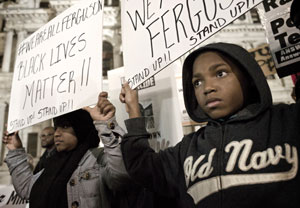
A child and his mother hold signs at Dillworth Park across from Philadelphia City Hall during a Black Lives Matter demonstration.
Black Lives Matter and Ferguson Action began when a handful of youth gathered together and stood their ground. They camped out. They tweeted out. They spoke out. For about a month, few paid attention. But as they persisted, more demonstrators joined their ranks, drawing national attention. In October 2014 the movement organized a four-day event called the Weekend of Resistance, in which more than 1,000 protestors from across the United States marched in downtown St. Louis.
“On the 70th day of this nightmare, some may wonder why we have yet to stop—to stop chanting, stop marching, stop occupying,” wrote Ferguson Action leaders such as DeRay McKesson (@deray). “We have not yet found peace because we do not yet know justice. Therefore we, together with our allies, will continue to occupy the streets and the American consciousness until the book is closed.
“You must come face to face with the horror that we live daily. You must come to know and profess the truth of this story, and be determined to end it. We are not concerned if this inconveniences you. Dead children are more than an inconvenience. We are not concerned if this disturbs your comfort. Freedom outweighs that privilege. We are not concerned if this upsets order. Your calm is built on our terror. We are not concerned if this disrupts normalcy. We will disrupt life until we can live.”
All lives matter?
The critiques began almost immediately. The most common retort I hear is “All lives matter.” On the surface, the reply reflects a misunderstanding: the point is not to say that only black lives matter; it’s to make black lives matter in a society where they don’t. In a deeper way, though, this retort has driven the movement to continually expand its boundaries.
In a culture where black denotes violently enforced marginality, Black Lives Matter is just another way of saying, “All oppressed lives matter.” Women’s lives matter. Red and brown lives matter. Poor lives matter. (White lives matter too, of course, but our society already believes that.)
“[James] Cone’s statement that ‘God is black’ has always been grounded in Jesus’ Jewishness and the biblical narrative which presents God as being in solidarity with the oppressed,” writes Daniel José Camacho in a June 2 story for Religion Dispatches. “As he has clarified on numerous occasions, it is a symbolic statement and not a statement of biology or literal skin color. . . . That some hear God’s blackness as a zero-sum statement is a mistake. In an interview this past January, Cone told HuffPo’s Paul Rauschenbush: ‘God is red. God is brown. God is yellow. God is gay. . . .
I don’t use blackness as a way to exclude anyone.’ ”
Our response matters
Lifting up and centering on blackness is a way for the church to meaningfully confess, lament, repent, and transform racial injustice and hurt.
Despite the tireless ministry and advocacy of mission coworkers, the Office of Public Witness, the Office of the General Assembly’s Committee on Representation, and many others, racial justice has generally occupied the periphery of our church’s concerns. We have been content to pursue diversity without unsettling our own racial privilege.
That, for some, is changing. Launched by Racial Ethnic & Women’s Ministries, the campaign Ask Why You Matter to Me is a churchwide effort to recommit Presbyterians to racial justice and faithfully proclaim that the lives of people of color matter. The project is rooted in biblical principles that call human beings to recognize and honor the image of God in one another.
Presbyterian congregations are also stepping up. In Ferguson itself, two retired Presbyterian pastors are actively at work. Ellie and Carleton Stock are part of a local ministerial alliance that has partnered with black clergy to lead marches and vigils. “We’re hoping that this event will catalyze some of these conversations about racism and white privilege [and lead to their] dismantling,” they told Bethany Daily in a Presbyterian News Service article.
“I think justice seeking has to be the work of the whole church in daily life, which includes the participation of those in our congregation who might see justice work as incidental rather than central to their lives,” says Joseph Morrow, a teaching elder and Presbyterian Mission Agency Board member who works with Interfaith Youth Core. “It’s not easy to embrace this more mundane approach, but that is also where transformation both occurs and is sustained.”
This mundane approach requires that we go beyond diversity and the mere chastising of overtly racist statements and actions. It requires careful attention to root causes and the underlying systems (of education, economics, religion, etc.) that make, in George Orwell’s famous words, some more equal than others.
“As Presbyterians, we must stop giving lip service to a new church while failing to confront the vestiges of racism,” says J. Herbert Nelson II, director of the Office of Public Witness. “Most often our preference has been to wait for General Assembly statements or other entities of the denomination to provide litanies, prayers, and words of confession or healing. However, it is imperative that local congregations not remain silent and idle amid community strife.”
“Churches must provide a moral compass for the nation by getting involved in shaping public policies that will move our nation towards justice, peace, and reconciliation,” Nelson says in the 211th General Assembly (1999) statement “Facing Racism: A Vision of the Beloved Community,” which draws on the Confession of 1967.
Admittedly, this isn’t easy. Anything that challenges our assumptions and frameworks naturally makes us want to dig in our heels. We all have different comfort zones. Different methods. Different abilities. Not all Presbyterians think the Black Lives Matter movement is the right way to go about achieving what we (should) all agree is our mandate: to pursue dignity, justice, and reconciliation for all God’s children.
But what we can do is listen. We can speak up when our suffering brothers and sisters ask us to stand up with them. We can pour resources into the Office of Public Witness and boost its work. We can connect with individual families—the ones who look different from us, speak a different language, or are facing deportation, imprisonment, or daily violence. We can embody this transformative justice right on the same streets where we go to church.
The little moments
At the very least, we can do something for Makaya.
As I looked at her and the other kids sitting in the van, my mind went to McKinney, Texas, and 15-year-old Dajerria Becton pinned beneath the body of police officer Eric Casebolt. The video replayed in my mind, and I couldn’t fathom what she must have felt as her face was ground into the dirt by the officer’s foot; or as her air was slowly stolen from her lungs as she cried for her mother.
I couldn’t fathom the fear and resignation, the confusion and anger, as she lay paralyzed by the weight of this man on top of her, a weight that she perhaps carries with her in her soul all the time.
Learn more and
take action
To get involved with the PC(USA)’s Ask Me Why You Matter to Me cross-agency campaign, visit pcusa.org/speakantiracism, tweet and follow the hashtag #SpeakAntiracism, and pledge to facilitate a conversation in your church.
For resources on racial justice, including how to host a conversation: pcusa.org/racialjustice
For more about historical and ongoing civil rights efforts in the church, see the September 2014 “Civil rights” issue of Presbyterians Today: store.pcusa.org
To connect with the Office of Public Witness: pcusa.org/washington
To learn more about Black Lives Matter: blacklivesmatter.com
But tall and lanky Makaya, strong and true, looks like she knows herself. And I think to myself that this is what love and justice look like—being rooted in your own courageous beauty and joy. And right there I imagine all kinds of possibilities for the kingdom work of resistance and reconciliation.
It isn’t just huge empires and principalities that need to fall but all the tiny moments that are drenched in whiteness and privilege and paternalism—all the subtle and insidious moments that say it’s OK to tackle a young girl, draw a gun on unarmed young boys, or drive by to shoot and kill a child in a park.
But there are other moments.
These moments in front of and behind a camera, or sitting in the back of a van, are where we clumsily open up space for our children to work and play and tell jokes—for small but eternal connections—where hammering nails is liturgy, laughter is prayer, and a smile is protest.
I look at the kids in front of me—all ages, all colors, all equally beautiful, all equally hyper, all equally obnoxious and adolescent, all equally innocent and wonderful and full of life. The light and love streaming from each one is blinding, and I can’t tell the difference, but I feel and see it from each one.
Each one.
Mihee Kim-Kort is a Presbyterian pastor and UKirk college minister at Indiana University in Bloomington.
