


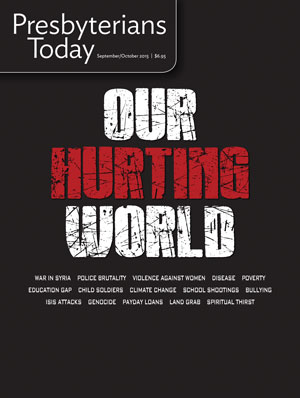
 Healing a hurting world
How to be a positive force for change without being a hero
by David LaMotte
Growing up in the ’70s, I had brown corduroy pants, a black-and-white TV, feathered hair, and a Trapper Keeper notebook. The widespread cultural turmoil of the civil rights era had largely subsided, and—other than the occasional school bully and a vague concern that nuclear annihilation might come any day—the cultural space I inhabited felt fairly calm and predictable.
I was born three weeks to the day after Martin Luther King Jr. was killed. By the time I entered middle school, it had been a generation since Rosa Parks’s famous arrest in 1955. Her story had aged enough to feel safe for textbooks. Parks was held up as a hero, a seemingly powerless little, old African American lady who had made a spontaneous decision not to give up her seat to a white man on a Montgomery bus and literally changed the world with her courage. So the story went.
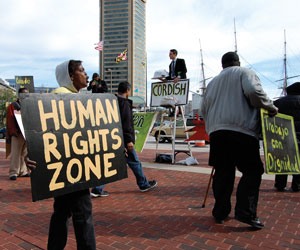
United Workers, partnering with Self-Development of People, demand an end to poverty in Baltimore.
I was inspired by that story, as I still am, but what I didn’t know as a young student is that the version I was being taught omitted much of the truth. What I wasn’t taught changes everything.
No one told me, for instance, that Rosa Parks had been the secretary for the Montgomery chapter of the National Association for the Advancement of Colored People for 12 years by the time she was arrested or that she had traveled to the Highlander Center in Tennessee for a 10-day training in voter registration and nonviolence shortly before her arrest.
On the day of the arrest, December 1, 1955, she was 42 years old, hardly a “little, old lady,” and her decision, though it wasn’t planned for that particular day, was rooted in years of undramatic daily work for change.
Here’s to you, Mrs. Robinson
No one on the bus with Rosa Parks tweeted the news of her arrest; no one reached hurriedly for a cell phone. Fellow passengers instead started making phone calls when they got home, and word quickly reached JoAnn Robinson, head of the Montgomery Women’s Political Council (WPC). For years, the WPC had been pressing the city and the bus company over abuses that “colored” riders (in the language of the day) were subjected to by bus drivers, who were all white.
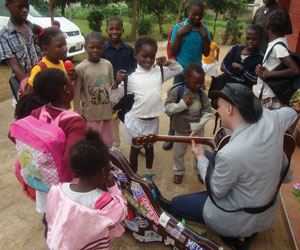
David LaMotte, right, takes a break during a conflict-transformation initiative in Lusaka, Zambia, to play for kids at the orphanage where he and his colleagues were staying in 2014.
Robinson made a few calls of her own, and late that night she made the decision to call a one-day boycott for the following Monday. From midnight until seven, Robinson and two of her students made copies of a flyer and distributed them around the city.
By the time local pastors arrived for a previously scheduled meeting at 10 on Friday morning, more than 50,000 flyers had blanketed the black neighborhoods of Montgomery. The pastors had little choice but to get on board, as it were.
Don’t miss this: JoAnn Robinson, a college professor and civic leader whom almost no one has heard of, called the Montgomery Bus Boycott, which had been organized and ready to launch for at least 18 months before Rosa Parks’s arrest.
Want to change the world? Make some copies.
JoAnn Robinson did what Rosa Parks also did: she gathered with others who shared her concern, and together they plotted a way forward, undramatically and over time, fitting those efforts into already busy lives in ways that were sustainable. We carve away facts from that story until it fits the lone-hero narrative, but, in truth, it is a movement story.
Do we follow . . . or just believe?
It’s hard to read the New Testament and miss the idea that followers of Jesus are called to change the world: to care for each other across established cultural boundaries, to create and nourish better ways of being community, to meet people’s tangible needs. By Jesus’ example, they are sent also to throw over tables in the temple, to question stone throwers, and to challenge the systems that make people needy. In short, to follow, and not just believe.

Austin College, a Presbyterian-related school in Texas, empowers students to connect their studies with global outreach.
My father is my favorite theologian. He is not a famous author or professor, but he is the kind of person who reads his Bible every morning. In Greek. And, more importantly, his knowledge of theology is not abstract. He tries very hard to apply it to his daily life and does about as well with that effort as anyone I’ve known.
Two years ago, when North Carolina legislators were passing a raft of laws that, in the eyes of some, hurt poor citizens and benefited wealthy and powerful ones, my father looked at the text of the laws, then at the text of his Bible, and couldn’t escape a sense that he needed to participate in what came to be called the Moral Monday movement, a set of ongoing protests of the state government’s actions. Singing and praying in the state legislative building, he was arrested. His arrest, among mine and others, captured the attention of many people who might not have noticed the legislators’ actions otherwise. An 81-year-old, retired Presbyterian minister with no prior history of arrest may not be what most people picture when they hear the word activist. And not all Presbyterians of course will agree with my dad’s actions or interpretation of the legislation. But, for my dad, living faith required him to join hundreds of others who were arrested that year, to play his part in a movement for justice.
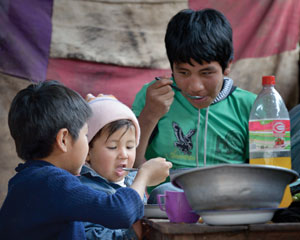
Guarani indigenous children in Choroquepiao, a small village in the Chaco region of Bolivia, eat produce from their new gardens developed with the help of the Presbyterian Hunger Program.
In a world, though, that ceaselessly offers us live images of its most terrible suffering and injustice, how do we sustain that kind of commitment without losing hope or energy? First comes the self-doubt: in the face of such large and systemic problems, who are we to think we can have an impact? Then the practical questions: Being so busy, how can we hope to fit more in? And where do we start? What’s most important? With an overwhelming list of problems that are both urgent and important, it is not surprising that many of us throw up our hands in despair and turn away.
I have come to believe that this understandable cynicism about our capacity to make an impact is rooted in a larger narrative about how change happens.
Stories matter
I first read of the hero narrative in Paul Loeb’s book Soul of a Citizen. In a nutshell, the hero narrative says that for large-scale problems to be addressed effectively, a hero (someone fundamentally different from the rest of us) must respond to a moment of crisis with dramatic action. Then things change.
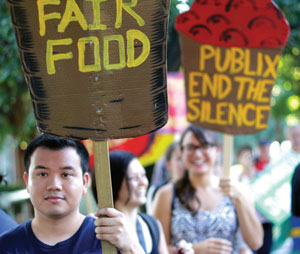
Presbyterians join the Coalition of Immokalee Workers to demand fair wages and human rights for farmworkers in the Florida tomato fields.
If you don’t agree that this is our dominant understanding, I suggest you drive by the biggest movie theater in your town and count how many of the movies on the marquee have that plot. To be clear, I’m talking not just about Bruce Willis movies but about Frozen and Harry Potter and countless other films. This story is deep in us.
The competing narrative is much less popular but has the benefit of actually being true. It says that things change on a large scale when a lot of people make a little bit of effort in the same direction.
A caveat: some, convinced of this alternative story, argue that no positive effort is wasted. I don’t go that far. It may be true that such effort works our compassion and engagement “muscles,” but, looking at my own life, I can point to many well-intentioned efforts that don’t seem to have amounted to much.
So, I am not arguing that all small efforts lead to large changes. Rather, I am suggesting that all large changes are made up of a myriad of small ones.
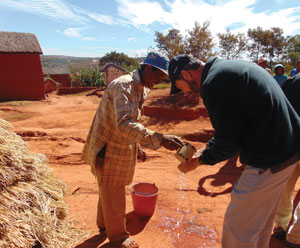
Hunter Farrell, right, director of Presbyterian World Mission, washes his hands in clean water in the rural village of Tsaramiakatra, Madagascar. Mission coworkers Dan and Elizabeth Turk worked with partners to install a gravity-fed water system, bringing fresh water to the village for the first time.
The consequences of our chosen narrative are huge and become dramatically clear when we think about the instructions we gather from it. If you want to see a change, what’s the first thing you need if you’re listening to the dominant narrative? A hero.
Most of us, I would wager, don’t wake up feeling terribly heroic. So where do you get a hero? The truth is, I’m not sure. So, step one boils down to this: wait. Wait for the hero.
But let’s say that a hero miraculously shows up. If we check that one off, what’s the next thing we need? A crisis, right? Where will we find a crisis?
I don’t know for sure, but I guess one will come around if we wait. That’s step two: wait some more. (More often than not, of course, the crisis will be the discovery that the hero is not in fact a hero at all.)
And step three? There’s no step three, because we never get past steps one and two.
We may understand in our heads that the hero narrative is not true (after all, we should really only have one hero, Christ, and that’s a hero who commanded us to follow in the power of the Spirit), but it seems to me that most of us, most days, live our lives by that story. We see big problems, and in response . . . we wait.
We make the way by walking
If we subscribe to the movement narrative, however, our instructions are very different. Mostly, they boil down to this: figure out what small thing you are called to do today and get to work.
If the role of world changer does not require being a hero, then I might qualify with whatever ordinary gifts and talents I bring. Biblical characters whom we often paint as heroes have a long list of inadequacies that they are quick to point out to God: “I don’t even talk right.” “You want my brother.” “I’m too young.” “I’m too old.” “I’m the wrong tribe, gender, etc.” But God works out God’s plans through us—regular, fallible people who, just like those biblical characters, choose to follow. We are not expected to be perfect or never stumble. It is enough that we stumble toward the light.
Where do we start?
What, though, should we do? In a big, broken world, glutted with violence and oppression, it is hard to know where to start. We are taught, in the interest of efficiency, to ask, What is most important? Activists (meaning anyone who chooses to take action, however small, in the face of a problem) can spend a lot of time arguing with each other over whose issue matters most.
Consider this, though. What would happen if one of us convinced everyone else that we should all be working on one problem, and everyone stopped working on all the others? No matter which issue it is, no matter how important, neglecting every other issue would quickly lead to complete destruction.
For people of faith, moreover, What’s most important? is the wrong question. Instead, it might be better to ask: What is mine to do? What work is God calling me to in this moment?
Once again, we have to be careful to bring this into scale. We are not discussing your life’s calling. I honestly don’t think you have one.
I think you have thousands. Big ones and little ones—a conversation you are called to have tomorrow morning, a smile you are called to offer in a particularly difficult moment. These can change, well, everything. Instead of asking, What do I do with my life? we should ask, What do I do next? That’s a much more manageable question.
Another issue with the hero narrative is that it tells us that service is built largely from suffering and sacrifice. To be sure, there are times when challenging oppressive systems is truly costly and even dangerous. But chances are that you will have a much greater effect over time if you can sustain yourself for the work.
What happens if we bring our joy, rather than our misery, to the work at hand? Pastor Howard Thurman, who was a mentor to Martin Luther King Jr., put it well when he said: “Don’t ask what the world needs. Ask what makes you come alive, and go do it. Because what the world needs is people who have come alive.”
My friend Katherine Neville is a professional accountant. She is good with numbers and has told me that she gets satisfaction from making them all fit into a large and complex system, like finishing a jigsaw puzzle. I get that in the abstract, but I have to say that this is neither my joy nor my gift.
In 2004, while on my honeymoon in Guatemala, I felt called to help out with a school there that was in desperate need of some work. As a folksinger married to a public school teacher, I didn’t have the necessary money, but I did have the opportunity to tell people stories at my concerts, and I thought I might be able to raise some money to help out.
It worked, and that small gesture grew into a nonprofit organization, PEG Partners, that has continued to grow and now has partnered with more than a dozen schools and libraries in Guatemala, supporting literacy, critical thought, and artistic expression.
My friend Katherine signed on as the CPA and treasurer for PEG, and in that role she has touched the lives of thousands of Guatemalan children. I assure you that if I were keeping the books, the organization would not have survived.
Still, when a young person comes to you and says, “I want to change the world; what should I do?” I doubt that your first response will be, “Well, first, you should go to accounting school.”
Maybe it should be.
Where to from here?
On my own days of discouragement and frustration, when I am tempted to move into the house of despair and lock the door, I have found it useful to work through a small list of questions and instructions.
The best approach I have found is to scribble down the very first answer that comes to mind, whatever it is. It’s hard for Presbyterians, I know, but try not to overthink it.
(1) What do you care about? We could rephrase this as What’s bugging you? or What is going on around you, on any scale, that just doesn’t seem right? Or, conversely, What do you see people doing that really inspires you and gives you faith in humanity?
(2) What do you bring? There are two parts to this question: What are you good at? and What do you love? This is no time for self-deprecation—you are good at some things. What are they?
(3) Where is your community? Where will you find the people who care about what you care about? Maybe this community already exists and you need to join it. Maybe you need to gather it together.
(4) What will you do? Where do the gifts you mentioned intersect with the things you care about? Choose something small and achievable, maybe something you can knock out this week. Don’t get overwhelmed. And bring this question to your community of purpose. Chew on it together.
(5) Do that thing. It might help to write your answers on a slip of paper and put it somewhere that will annoy you until you do it.
(6) Rinse and repeat. What did you learn? Are you drawn further into that work? To other work? Go back to step one.
It’s important to note that undramatic efforts that change the world do not necessarily address world-scale problems head-on. If you want to see a world where families care for each other, and your primary calling right now is caring for your kids or a sick father-in-law, that is a brave and beautiful vocation. That’s part of how you create the world you want to see. No one else can tell you what you are called to. Listening and asking for that guidance, though, can lead us to a deeper and more faithful life.
Learn more and
take action
Check out David LaMotte’s new book, Worldchanging 101: Challenging the Myth of Powerlessness (Dryad Publishing, 2014): davidlamotte.com/worldchanging-101.
For practical strategies to achieve change and plenty of options for your involvement through the church, see the article “The perpetual rule of love” in The Presbyterian Resource Guide for Ministry (pp. 24–26): store.pcusa.org. You can also read this article for free online: pcusa.org/social-change.
I truly believe that these small efforts are how the world changes, and Presbyterians need to wrestle with our roles in those changes.
That said, it still sounds somewhat naive and childish to talk about “changing the world.” Who do we think we are? If we drop that phrase into casual conversation with friends, with no sense of irony, there may be some chuckling or eye rolling.
It only sounds naive, though, because we are being sloppy with our semantics. We use the phrases “change the world,” “fix the world,” and “save the world” interchangeably. They are not the same thing. If we think we can fix the world, we are guilty as charged: naive, and the job of savior is taken. Changing the world, however, is different. It is not naive to think you can change the world; it is naive to think you could possibly be in the world and not change it. The question is, Which changes will we make?
David LaMotte is a songwriter, author, speaker, and workshop leader, as well as the president of PEG Partners. He considers himself a Quakerterian, with one foot planted in Quakerism and the other in the PC(USA). He lives in Black Mountain, North Carolina, with his wife and son.
